
The agents and brokerages that pull ahead are rarely the ones chasing more deals or more bodies. Instead, they build systems, extra income streams, and a name people remember, all while staying attuned to the mergers, revenue share models, and capital moves reshaping the business around them.
That bigger question drives this episode of the Why Do I Suck as a Real Estate Agent podcast, where I sat down with Dana Flanagan of Brands by Integra, a growth strategist with more than two decades in the business, to unpack the mergers, revenue share, and capital moves most agents never see behind the scenes.
Curious about this episode? Here is a quick preview of our conversation before you dive in. Watch the short clip here:
Why the Real Estate Recruiting Playbook Stopped Working
For years, the growth move was simple. Recruit more agents, add more names, repeat. Dana made it clear that the playbook is losing its grip. People are tired of being recruited, and they have heard every pitch twenty times over. What earns a move today is solving a real problem, not selling another one-size-fits-all model.
That shift is exactly why brokerage mergers and acquisitions and strategic partnerships matter now. Instead of pitching, Dana's team asks a better question. What are the actual pain points, and what would a perfect setup look like for this agent or this brokerage? Then they build a plan around the answer.
This clicked for me because of what I keep hearing on this show. Agent after agent tells me they feel like they are on an island. One recently admitted she had not spoken to her broker in three months while sitting on real questions.
Support and community turn out to matter as much as any comp plan, which is part of why so many agents cycle in and out of the field. The federal jobs data backs this up, with tens of thousands of openings projected every year largely because people leave or retire out of the business, a pattern you can see in the long-term outlook for real estate brokers and sales agents.
I think about that a lot as I keep building a community-focused real estate brokerage here in Northeast Wisconsin. Growth is not about headcount. It is about belonging and real support.
Watch the full conversation here:
What Growing Brokerages Do Differently to Scale
The brokerages that are actually growing lead with options and flexibility. Dana walked me through her hybrid setup. Some agents still want a brick-and-mortar office. Some want a fully cloud-based model. Many want something in between, an office in town they can visit for a meeting or a training without sitting there every day. Meeting agents where they are solves a problem for almost everyone.
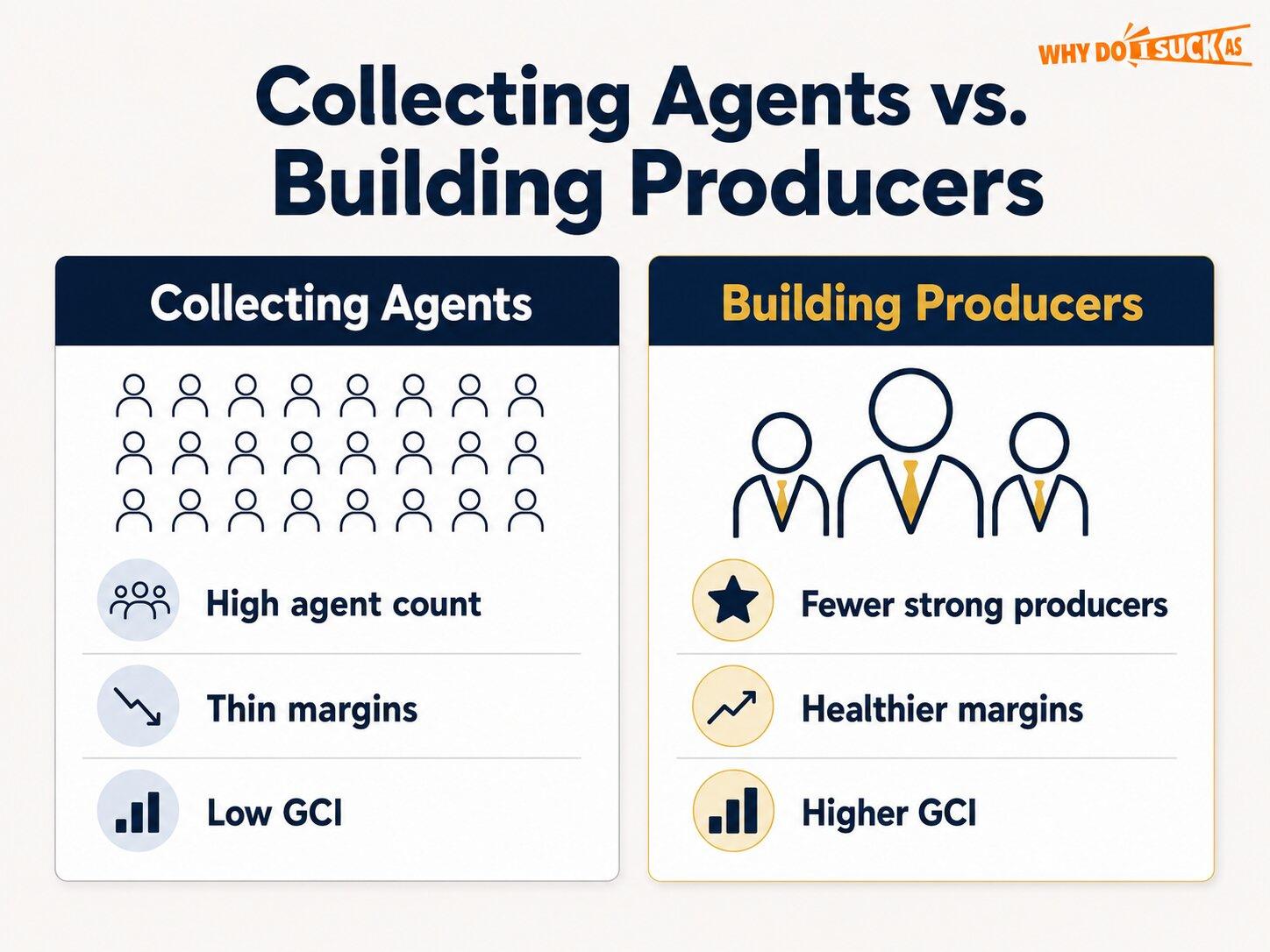
The most common way brokers stall is the opposite move. They collect agents. Fifty here, seventy-five there, and most of them part-time or barely producing. The result is thin margins and weak GCI. A few strong producers or teams will out-earn a big roster every time, which is why scaling a real estate brokerage is a systems problem before it is a sales problem.
The other quiet difference is operations. Dana was blunt that when a broker-owner tries to wear every hat, that is where things break. The winners have a dedicated operator or a plug-and-play partner running the systems so everything talks to each other instead of getting pieced together. I learned that the hard way, adding an assistant, a transaction coordinator, a marketing person, and eventually a COO.
It took real trial and error, and it is the foundation the sales side sits on. That systems-first mindset is close to how Dana Flanagan approaches brokerage growth and partnerships every day, and it mirrors our own push to grow the brokerage the right way rather than the fast way.
Breaking the Deal-to-Deal Cycle With Systems and Leverage
Most agents live deal to deal. The instinct is to do it all yourself, and that instinct is the trap. Dana's first hire was a transaction coordinator, so she could stay in front of clients instead of buried in paperwork. Leverage, not hustle, is what moves you to the next level.
Here is how she put it, and it stuck with me:
"Having the right systems in place. My first hire was a TC, a transaction coordinator that handles all of my paperwork, so that I could be out front and center selling. You've got to provide leverage, and realtors, we're all A-type personalities. They don't want to give up and delegate. So it ends up being this, 'I can do it faster myself,' but really you're sort of holding yourself back. Because if you're doing all the paperwork, you're doing all of the sales and marketing, you're doing the cold calling, you're doing the listing appointments, you're doing the buyer showings, at some point your time is going to be eaten up. Focusing on one thing, maybe being a listing agent, which is what I did toward the end of my business. In my last 10 years, I did only listings. I had three buyer's agents on my very successful team, and I did that on purpose. But finding that leverage, knowing what you're good at and what you suck at, so that you can put those systems in place in the positions where you're not necessarily as good, or want to do those things." — Dana Flanagan of Brands by Integra
The self-awareness piece is the whole game. Get honest about what you are great at and what drains you, then build hires and systems around your weak spots. Dana went listings-only for a decade and let strong buyer's agents run showings, and it worked because she stopped trying to be everything.
If you are stuck around ten or fifteen deals and feeling underwater, start with one move. Find the single task eating the most time, usually paperwork or admin, and hand it off first. Dana breaks these ideas down often, and she shares practical growth strategies on Instagram if you want to see the mindset in action.
Turning Revenue Share Into Long-Term Passive Income
The revenue stream almost no one builds is the one Dana leaned into hardest. Real estate revenue share passive income is true residual income that keeps paying after you stop selling. Some people call it mailbox money. With many companies, it is even willable to your family, which turns a career into a legacy instead of a grind.
The reframe matters. Attraction is not recruiting. It is telling people why you love where you work. Dana pointed out that agents rarely get a retirement party. They just fade out, and everything they built fades with them. Building income that pays while you sleep is how you avoid the hamster wheel, and Dana coaches on exactly this kind of scaling through her work helping realtors and business owners grow.
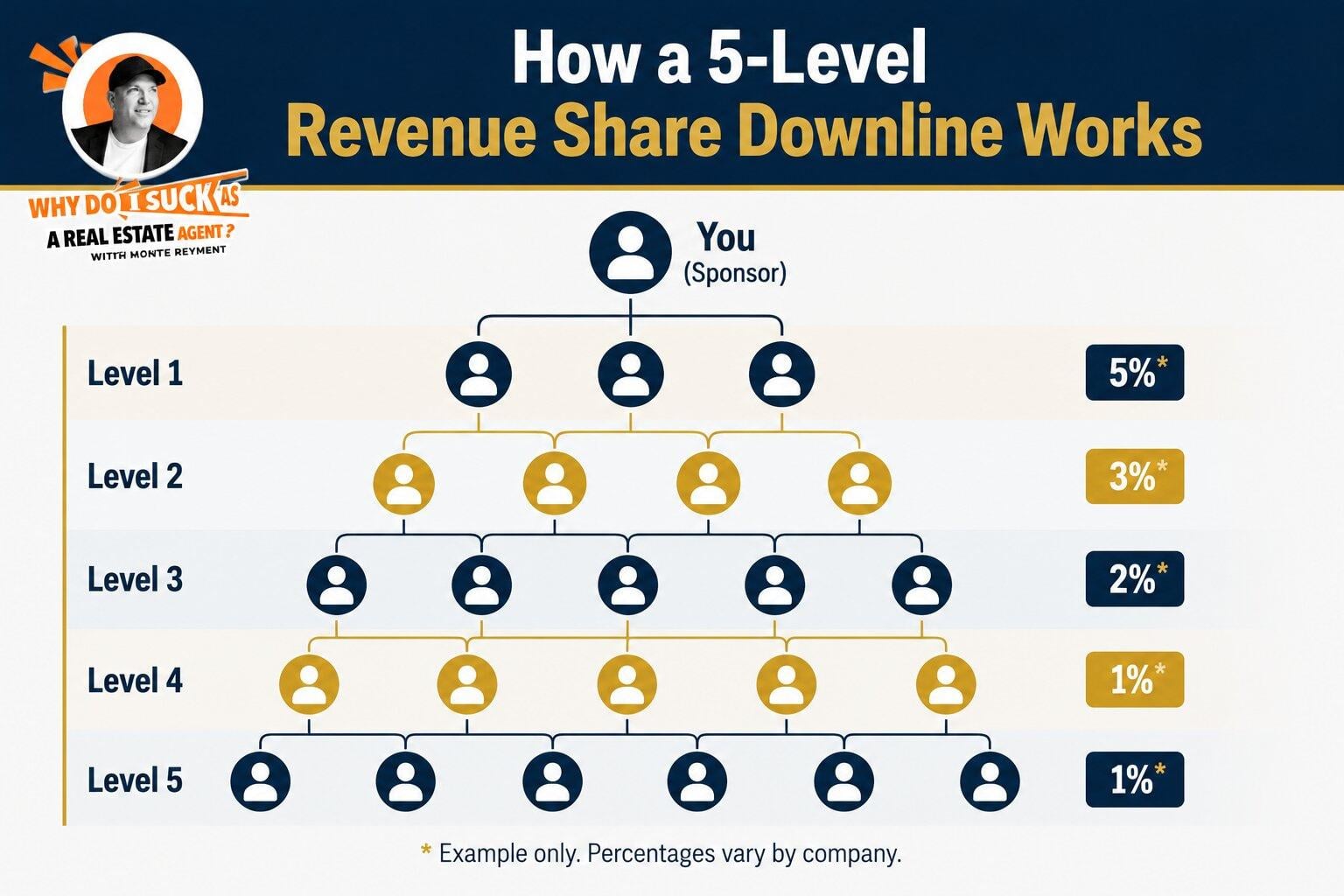
The mechanics are simple once you see them. You earn a percentage of the company dollar on the production of agents in your organization, typically five to seven levels deep. Bring in one strong attractor, and they may bring in a hundred and fifty more, so the organization compounds over time. Dana first saw this with Keller Williams back in 2012, watched her income double, and still collects that revenue share every month years after leaving. That is the part most agents slow down too late to build.
The Capital Funding and Creative Financing Most Agents Overlook
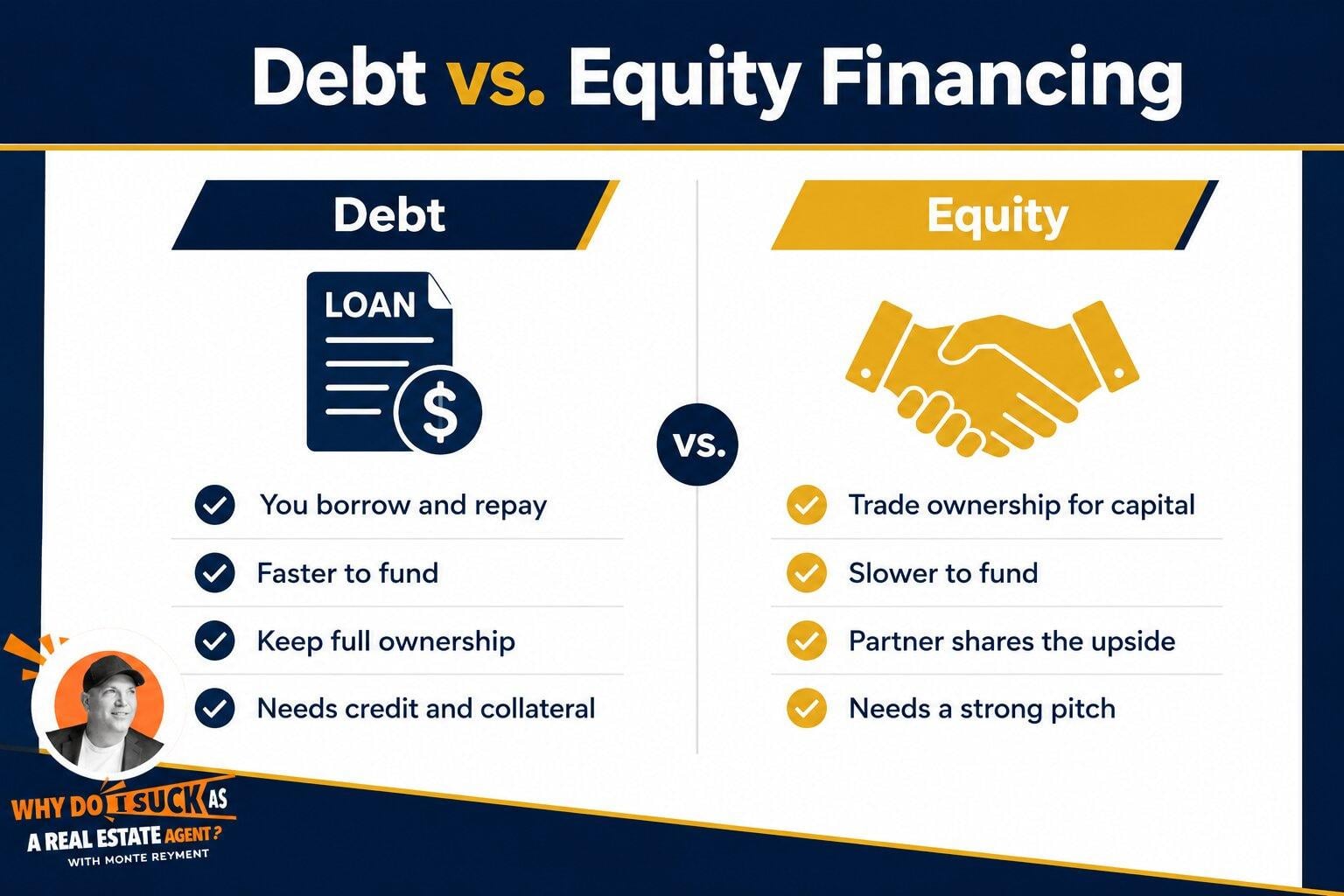
This is where the conversation went from big to huge. Dana works the private capital side, and she explained it in plain English. Capital funding for real estate investors breaks into two lanes, and knowing the difference changes how you think about growth.
"There are two sides of what I do. The debt side, where that person needs a loan, except they're not going to get it through a traditional bank. So they're looking for 25 million to develop a shopping center, and they come in through our firm, and we underwrite them a lot of the same ways that you would underwrite a mortgage. And then we have the equity side, which is kind of like Shark Tank, where somebody is looking for two million, and they need an equity partner. They don't necessarily want to have a loan, so we'll have an investor come in for a portion of their company or their project and provide them that equity that they need to get going. So debt is a lot easier to get funded than equity, and it's a lot faster. We have some ways that we can finagle things a little bit better than a traditional mortgage broker or a bank, but you still need to have decent credit, you still need to have some skin in the game. It can't be a pie-in-the-sky opportunity." — Dana Flanagan
If you want the quick primer, debt means borrowing and equity means trading ownership for capital, and the federal small business guidance lays out the difference between debt and equity financing cleanly. Dana's favorite deals are asset-backed real estate, because a tangible property is easier to underwrite than a startup idea.
The most eye-opening idea was leverage. Dana described buying property using little of your own money by pulling equity from one home to fund the down payment on the next, then repeating the cycle. She knows someone who stacked that approach across thirty-one properties. It works, but only with discipline, which is why understanding how a home equity loan lets you borrow against your property matters before you try it.
The biggest mistake she sees is showing up unprepared. No pitch deck, no executive summary, expectations out of line with reality. Funders want demographics, a multi-year pro forma, and a clear story for how they get their money back. Dana even runs an advisory practice that gets people investor-ready, and you can request one-on-one advisory to prepare for capital if that is your next step.
How Dana Flanagan Changed the Way I Think About Staying Relevant
The part I keep coming back to is about being remembered. Dana's advice on lasting in this business was the strongest note of the whole talk.
"Get networked. You need to get out there and be visible. Give yourself that exposure. Be visible in your community. Get networked and be visible, because if you're not visible, you're forgotten. The people that are visible, especially online on social media, if you're not leveraging social media, you're way behind already. Create relationships where people know who you are, and they feel they connect with you. And differentiate yourself with your own brand. Stop worrying about what brand you work for. Brand yourself, so if you ever need to move, or you are moving, you can take that with you, and you never have to be worried about using the company email address or whatever it is that you did, because you branded yourself. So get networked and get out there. Make sure people know who you are." — Dana Flanagan
That is why real estate agent branding and networking is the durable advantage. I have watched agents brokerage-hop chasing greener grass without ever building a personal brand, and it never works. Nobody hires me because of the sign on the building. They hire me. Dana lives this too, from her runs on House Hunters and American Dream TV to the four shows she has produced, and it runs through her approach to authority and visibility.
We also agree on AI. It will sharpen the resourceful agents and quietly retire the ones coasting, but it will not replace the personal touch a big, emotional decision demands. Dana uses tools like ChatGPT to draft and refine, not to replace real conversations, and neither do I. The edge is being known and being human.
You can see it in the smallest actions. A new agent joined my team, walked one neighborhood near Lambeau Field for two hours, knocked on doors, and pulled three listings. That is visibility and relationships in action, and it is repeatable. When you feel like you are struggling, Dana's honest advice is to get on a team, learn your strengths, and lean on people who are already winning. For agents feeling burned out, she also built a support system for entrepreneurs facing burnout, and she stays close to her community over on her real estate and business page on Facebook.
If this conversation lit something up for you, that is the point of the show, and you can follow our team's real estate work in Northeast Wisconsin or see how coaching and leadership shaped our growth.
Curious about the full breakdown of how Dana Flanagan of Brands by Integra scales brokerages and builds passive income streams? Listen to our complete podcast episode!
Frequently Asked Questions About Brokerage Growth and Revenue Share
Why is traditional real estate recruiting losing its effectiveness?
Agents have been recruited many times and are tired of one-size-fits-all pitches. What earns a move today is solving a real problem, whether that is operations, leverage, or growth, with a plan built around the individual agent or brokerage.
What is the biggest mistake brokerages make when they try to scale?
Chasing agent count instead of production. A roster full of part-time or low-producing agents leaves thin margins and weak GCI. Growth is healthier when it centers on a smaller group of strong producers and teams supported by real systems.
How does real estate revenue share create passive income?
When agents you attract join a company, you earn a percentage of the company dollar from their production, often five to seven levels deep. Because it can keep paying after you stop selling and, with many companies, be passed to family, it can become a lasting income stream instead of another commission.
Apply to Be a Guest on the Why Do I Suck as a Real Estate Agent Podcast
Real estate is changing fast. Capital is moving, brokerages are merging, and the agents who last are the ones who build systems, leverage, and a brand that travels with them.
If you are working in the industry and solving real problems, whether in brokerage growth, finance, investing, or agent development, I would love to hear from you.
Check out this article next