


The biggest thing holding most real estate agents back is not the market. It is not their scripts, their CRM, or their lead source. It is who they believe they are.
That was the central argument on a recent episode of the Why Do I Suck as a Real Estate Agent Podcast. I sat down with Kevin Yoder, the founder of the Infinite You real estate coaching platform.
You can find the snippet of this conversation here:
We discussed the invisible ceiling that keeps talented agents stuck, no matter how hard they work. Like many others, I used to think that mastering the market or perfecting my sales pitch would be the key to success. But as Kevin and I delved deeper into the conversation, it became clear that the true game-changer lies within.
Listen to the full episode:
The Real Reason Agents Work Hard and Stay Stuck
I started this podcast because of a single conversation. A young agent walked into my office, frustrated and exhausted, and asked me point-blank: why do I suck at this? She had the drive. She had the work ethic. She was putting in the hours. What she did not have was the internal foundation to sustain the effort and trust the results.
That question stuck with me. It became this podcast. And it is exactly why I wanted Kevin Yoder on the show.
Kevin is not a motivational speaker selling a system. He is a 26-year real estate veteran who has navigated four major market cycles in Grand Rapids, Michigan. He ran a high-producing team. He coached agents across the country. And after all of it, he kept noticing the same pattern: the agents who struggled were not missing information. They were missing identity.
Building a real estate brand that attracts the right clients starts long before the logo, the website, or the marketing plan. It starts with who you believe you are before you ever pick up the phone.
Kevin made this point early in our conversation, and it set the tone for everything that followed. We live in an era where AI and online training give everyone equal access to the mechanics of real estate. The scripts are out there. The systems are documented. And yet, the production gap between top earners and struggling agents keeps widening. The information was never the missing piece. Strategy is not the problem. Identity is.
Real Estate Identity Before Strategy: The Invisible Ceiling on Your Commission Income
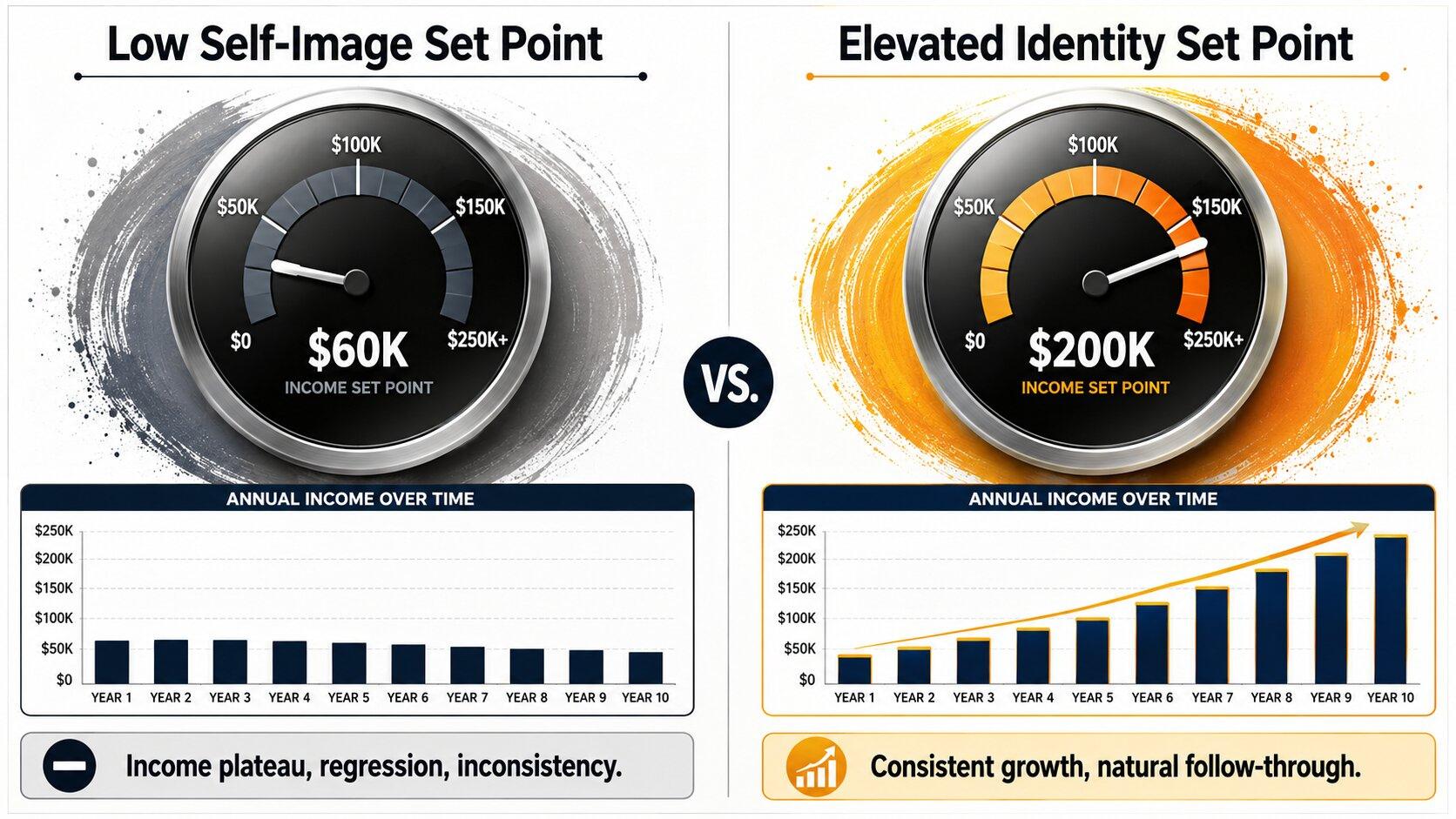
The most important insight from my conversation with Kevin centers on a simple but uncomfortable truth: your subconscious self-image functions like a financial thermostat. It regulates your behavior to match what you believe you are worth.
If your internal dial is set at $60,000 a year, your mind will allow the big months to happen. You will put five deals under contract. The momentum will build. And then, almost without noticing, something shifts. The call reluctance returns. The desk gets organized. The energy fades. You drift back to your baseline because your self-image is doing exactly what it was designed to do: seek consistency.
Research on self-image and behavioral consistency from Psychology Today confirms what Kevin has observed across decades of coaching. People operate within the boundaries of their perceived self-concept. The subconscious is not random. It enforces whatever identity you have assigned to yourself.
Kevin grounded this in the principles of Psycho Cybernetics for real estate agents, drawing on Maxwell Maltz's landmark work. Maltz documented how individuals unconsciously self-regulate to match their internal self-image, the same way a thermostat keeps a room at a fixed temperature regardless of the weather outside. He also referenced a teacher named Prescott Lecky, whose research showed that students labeled as poor performers dramatically improved their grades once their self-image shifted. Not their study habits. Not their tutoring. Their self-image. The results followed automatically.
Kevin unpacks the full mechanics of this in his work on shifting your paradigms. A paradigm is the filter through which every piece of incoming information gets processed. If a new idea does not fit the existing paradigm, the brain rejects it. That is why two agents can sit through the same training and only one changes their results.
Three shifts come from truly understanding this mechanism.
- Recognize that your income plateau is not a market problem. It is a self-concept problem. When you hit a strong month and then pull back, that is not laziness. That is the thermostat doing its job. Your first task is to reset the thermostat, not work harder within the same setting.
- Diagnose the action disconnect. If you know you need to prospect for two hours each morning but find yourself reorganizing your files instead, you are experiencing an identity mismatch. The gap in activity is a symptom. The root cause is internal, and fixing the symptom without addressing the root is why most training programs produce short-term results that fade.
- Shift the internal vocabulary before the external plan. Move from "I am trying to find clients" to "I am an elite advisor who provides unmatched market guidance." That shift has to happen at the identity level before it shows up in consistent daily behavior.
Overcoming Fear of Rejection in Sales by Rewiring Subconscious Programming
Every agent knows the feeling. The phone is right there. The expired list is pulled up. And somehow, the day fills up with everything except the one activity that actually builds the pipeline.
Kevin lived that cycle for his first seven years as a solo agent. He had a sales background and was producing. But he was riding the roller coaster: three deals one month, zero the next. Inconsistency was eating him alive. He would look around his office at peers who were not smarter, not more experienced, not more connected. They were simply producing more. And he eventually saw why.
The common denominator of success is not talent. It is not access to better leads or more impressive credentials. It is the consistent willingness to take uncomfortable action, specifically the willingness to collect the rejections required to get to a closing.
Kevin made the decision to pick up the phone and call expired listings and FSBOs. He made it once, and he made it with full commitment. The results were immediate.
"There is only one thing that was keeping me from doing as well as I could, and that was the capacity to pick up the phone, make the calls, and have those conversations with folks who didn't otherwise want to talk with me, but yet influence them to take a path that's in their best interest. And that's what I did. My business literally went like this. There's the hockey stick. Within the first six months, we went from six to twelve to eighteen to twenty-five to thirty million, all very quickly, by the result of that one decision. Just do it and do it consistently."
Overcoming fear of rejection in sales through the lens of psycho-cybernetics for real estate agents is not about eliminating discomfort. It is about building references. Every time you make the call and survive the "no," your subconscious updates its record. The rejection did not destroy you. You are still here. Slowly, the identity adjusts. The consistency becomes possible, and then it becomes natural.
Research on growth mindset and performance published in the Harvard Business Review confirms the same mechanism. You do not think your way into confidence. You act your way into it. Repetition builds the internal evidence that rewrites the self-image, one call at a time.
Scaling from Solo Agent to Real Estate Business Owner Using the Power of Leverage
One of the hardest conversations I have with agents is the one where I ask them to let go. Stop being the only person who can manage the client. Trust someone else with the experience they have spent years building.
The resistance is always real. The reasons always sound valid. What lives underneath, almost every time, is fear dressed up as standards.
Kevin described what keeps most agents stuck: an ego-driven belief that you are the only one capable of protecting the client experience. He is right. Most agents who stay trapped in transactional mode are not stuck because of a skill gap. They are stuck because their identity has not yet made room for leverage.
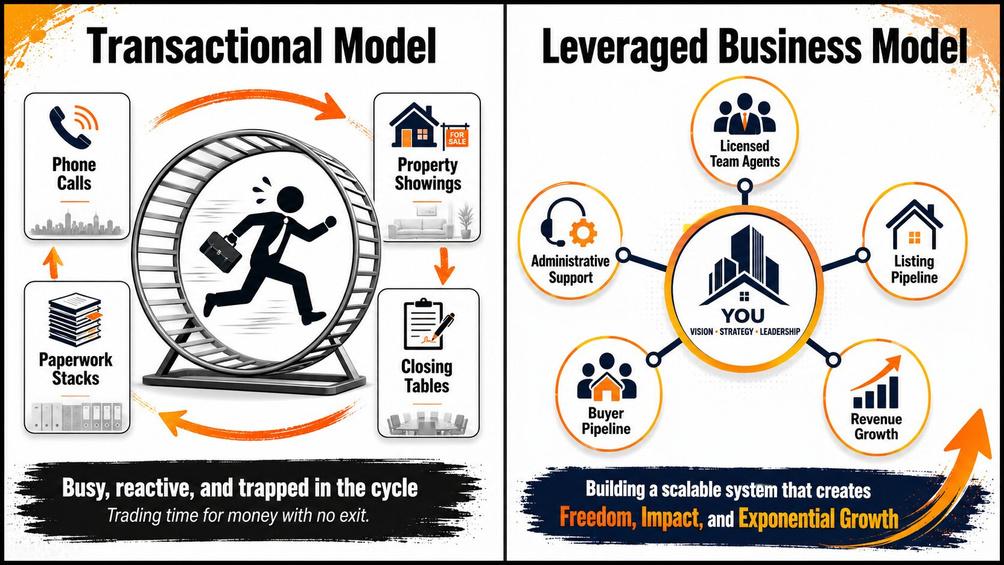
True scaling from solo agent to real estate business owner requires earning the right to leverage, and then actually claiming it. Kevin walked his first assistant through a clear, direct standard on day one. Double the business in year one. That is what happened.
I went through my own version of this at Take Action Realty Group. My wife and I went to Costa Rica for our twentieth anniversary. Before we left, six listings went live. Five transactions were closing the week we got back. My team handled it. I stepped in on a few things they had not seen before, but what would have previously occupied half a vacation took maybe two to three hours the entire week. That is what leverage feels like when the identity is aligned with it.
Real estate business structures and partnership models that scale are a recurring theme on this podcast because they represent what becomes possible once the internal work is done. Leverage is not about abandoning your standards. It is about trusting others to uphold them.
Kevin also connects this to what he calls money consciousness, which his program addresses directly in the lesson on real estate prosperity and financial abundance. If the thought of hiring an assistant triggers panic about whether you can cover the cost, that is not a cash flow problem. That is a self-image problem rooted in scarcity. The business cannot scale from that foundation.
Real Estate Agent Mindset Shifts Required to Survive and Profit in Modern Market Cycles
The next three years will separate agents who have done internal work from those who have not. Kevin's advice for any agent sitting in their car right now, questioning whether to stay in this business, was direct: look through the telescope, not the microscope.
The microscope keeps you locked on this week's deal that fell apart, the dismal balance in the operating account, the slow stretch of showings that went nowhere. The telescope gives you the long view: the legacy you are building, the income that compounds with experience and reputation, the life you are constructing for your family through this career.
Recent NAR member data illustrates exactly what that long view is worth. The median gross income for agents with 16 or more years of experience is $78,900, compared to just $8,100 for agents in their first two years. The agents who stay, grow. The ones who quit in year two never find out what they were building toward.
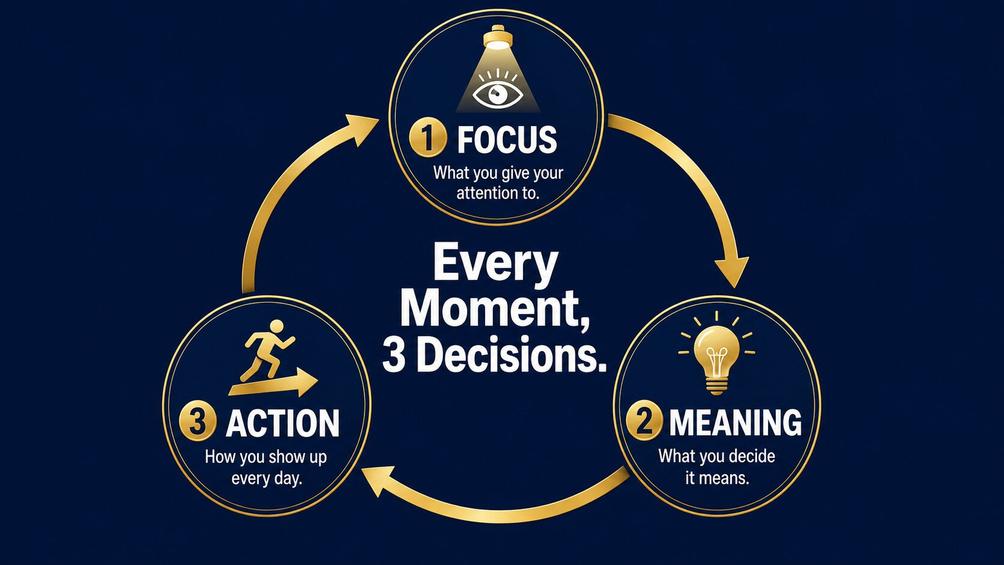
Kevin shared a framework he uses as a personal filter through every market condition. Three decisions. Every moment, consciously or not, you are making all three.
"We're all making three decisions at every moment. And I use this as my guide for most of the things I'm doing. You're deciding what you're going to focus on, in other words, what you're giving your attention to. And then secondarily, what meaning are you giving that? The good news is that we have the capacity as humans to pivot to a better thought and a better focus. You can shift that right now and decide that you want to focus on serving, and leveling up and getting better and improving."
This is the daily application of the real estate agent mindset shifts Kevin teaches. Control the focus. Choose the meaning. The action follows. You move from a state of preservation into a state of contribution, and contribution is exactly what a disrupted market needs from committed, experienced agents.
A dismal bank balance can mean failure or it can mean unfinished progress. The facts stay the same. The meaning you assign to them changes everything about how you show up the next morning.
What Changed for Me After This Conversation
This episode made me audit my own leadership. I built Take Action Realty Group around the idea that action is the answer. Forward movement. Accountability. Getting after it every day. But Kevin reminded me that pushing agents to grind harder is not the same as helping them grow.
True leadership guides agents through an evolution of self-worth, not just activity volume. When the identity shifts, the production follows as a natural byproduct. It stops being forced.
Kevin put the difference between a high-volume solo producer and a true team leader into words I will be using for a long time:
"Selling eighty units as an agent with single production says one thing. It says you're an excellent salesperson, marketer, perhaps a negotiator. But to suggest that you have a team that sells a hundred or a hundred and fifty, and you've trained other people to do it to your standards, and it's happening systematically, duplicably, repeatably, is a much higher degree of learning and sharing and growing, not only as a leader, but your example has been there to teach them how to do the same."
Moving forward, I am shifting how I coach my agents. Less emphasis on transactional targets, more focus on life goals that scare and excite them simultaneously. If the identity shifts first, the production takes care of itself.
If you want to work through that process with Kevin directly, his 12-stage Infinite You coaching program takes entrepreneurs from setting life targets all the way through expanding prosperity consciousness and building the self-image that makes consistent high production feel natural.
The mindset required to flip houses and transform communities follows the same internal logic: the external results always come after the internal shift.
Want to hear my entire conversation with Kevin Yoder as he breaks down why your self-image is the real driver of your commission checks? Listen to our podcast episode for the raw, unedited breakdown of how to break the fear cycle.
Frequently Asked Questions
What is the primary focus of the Kevin Yoder Infinite You real estate coaching platform?
The Infinite You platform is a structured 12-stage progression designed to help entrepreneurs rewire their subconscious belief systems, overcome internal blocks like call reluctance, and build a prosperity consciousness that aligns with high-level business success.
How do concepts from psycho-cybernetics for real estate agents help increase sales production?
Psycho-cybernetics proves that the human mind relies on a self-image regulating mechanism. By using spaced repetition and targeted identity shifts, agents can reset their internal financial thermostats, making habits like consistent prospecting feel natural rather than forced.
Why do top-producing agents stay stuck in transactional mode instead of scaling a team?
Most agents remain trapped on the transaction treadmill because of an ego-driven need for control and a lack of money consciousness. Transitioning to a true business model requires implementing leverage through administrative support and training others to duplicate your standards.
Apply as a Guest Speaker
Real estate is evolving. Capital is shifting. Markets are tightening. If you are actively working in the industry and solving real problems, whether in construction, finance, brokerage, or development, we would love to hear from you. It is a great way to share your blueprint for overcoming rejection and help other agents stop spinning their wheels on the transactional hamster wheel.
Check out this article next